Class of 1963 Authors exhibit opens

Class of 1963 Authors
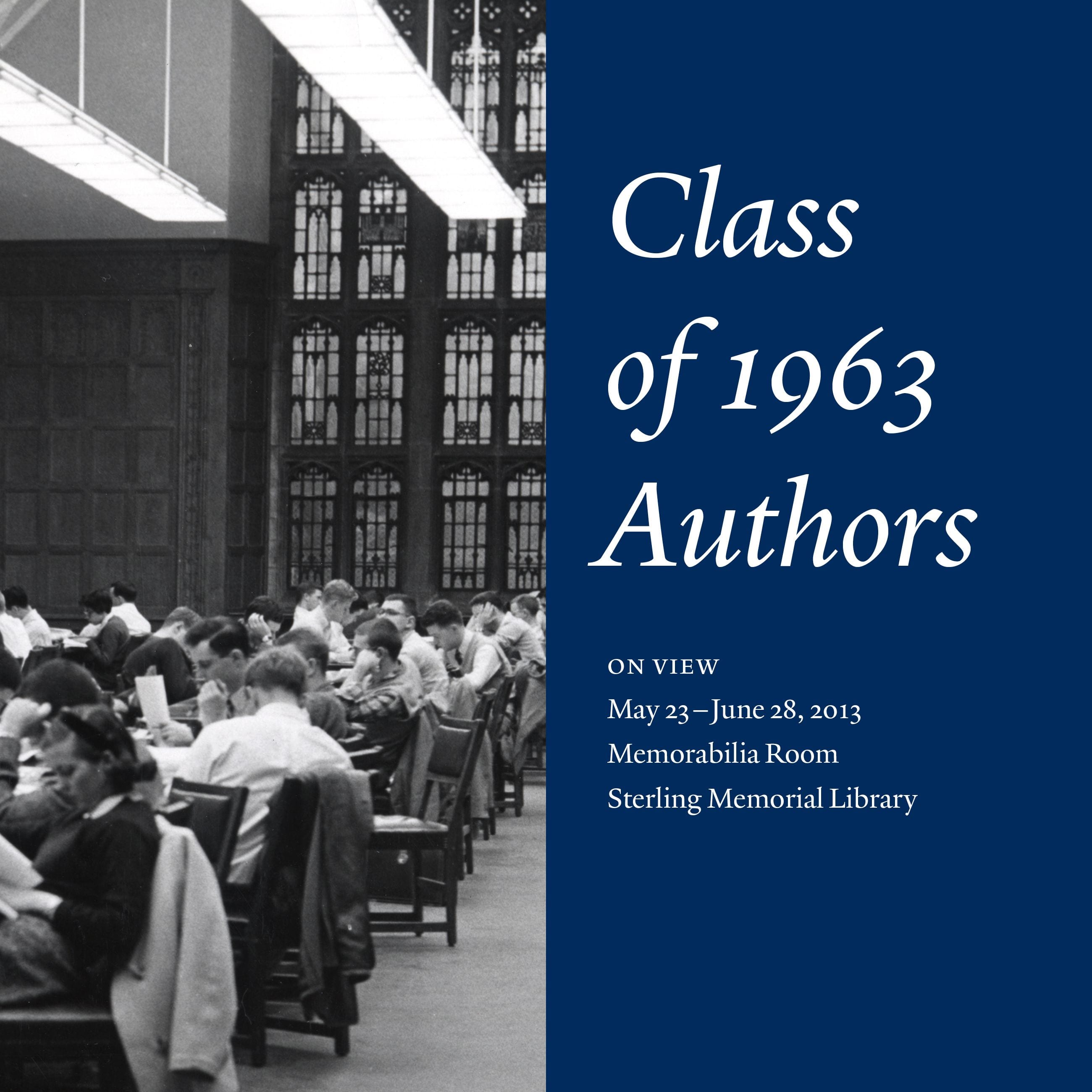
May 23 – June 28, 2013, Memorabilia Room, Sterling Memorial Library

This exhibit celebrates the prolific publishing output of the members of the Yale College Class of 1963, which is celebrating its 50th reunion this year.  The works of the seventy-six members of the Class of 1963 span many genres: scholarly monograph, travelogue, journalism, “how to” text, spirituality, memoir, poetry, biography, music, and fiction. The exhibit represents a collaboration between the Association of Yale Alumni and the Manuscripts and Archives Department of the Yale University Library. Content for the exhibit was solicited and assembled by Class of 1963 coordinators Guy Miller Struve, Laton McCartney, and Michael Koenig.

The exhibit is curated by Manuscripts & Archives staff members. The exhibit is free and open to the public Monday-Friday, 8:30 AM-4:45 PM. For more information about exhibits and events at the Yale University Library click here.


World War I Nursing Experiences of Elizabeth Hudson

The Elizabeth Hudson Papers (MS 1464, online finding aid here) comprises four albums that provide eloquent visual testimony of one woman’s impact serving as a nurse in Paris during World War I. Elizabeth, a native of Syracuse, NY, was born in circa 1885 and died in 1973. 

The albums contain photographs of Paris during the war and document the American Red Cross Military Hospital No. 1 (also known as the American Ambulance Hospital), which occupied a just-finished building intended to be a school (Lycée Pasteur of Neuilly-sur-Seine), but that was converted for wartime use as a hospital.

Other photographs include patients in the hospital, the French trenches at the front, and scenes in the French countryside during the war. In addition to photographs, the albums hold printed wartime ephemera, correspondence, war memorabilia, and captions for many of the photographs. Two of the albums contain photographs of Ms. Hudson’s patients, both French and American, and notes from them documenting circumstances of their injuries and thanking her for her work as a nurse. There are tipped-in sheets containing typed translations into English of many of the notes from French patients.

Wounded GIs on a ward with Elizabeth Hudson and another nurse

Wounded GIs on a ward with Elizabeth Hudson and another nurse

Together the albums provide poignant documentation about the experiences of a young American woman in her early 30s and her impact on countless patients who passed through the World War I military hospital in which she was working.

There is a related collection in the Beinecke Rare Book and Manuscript Library (GEN MSS 28, online finding aid here) of materials documenting Elizabeth Hudson’s friendship between the wars with the Irish author Edith Somerville, as well as her involvement in relief efforts during World Wars I and II.

Nurses taking a lunch break in the Canteen.

Nurses taking a lunch break in the Canteen.

Earth Day and May Day Cross-fertilization at Yale, 1970

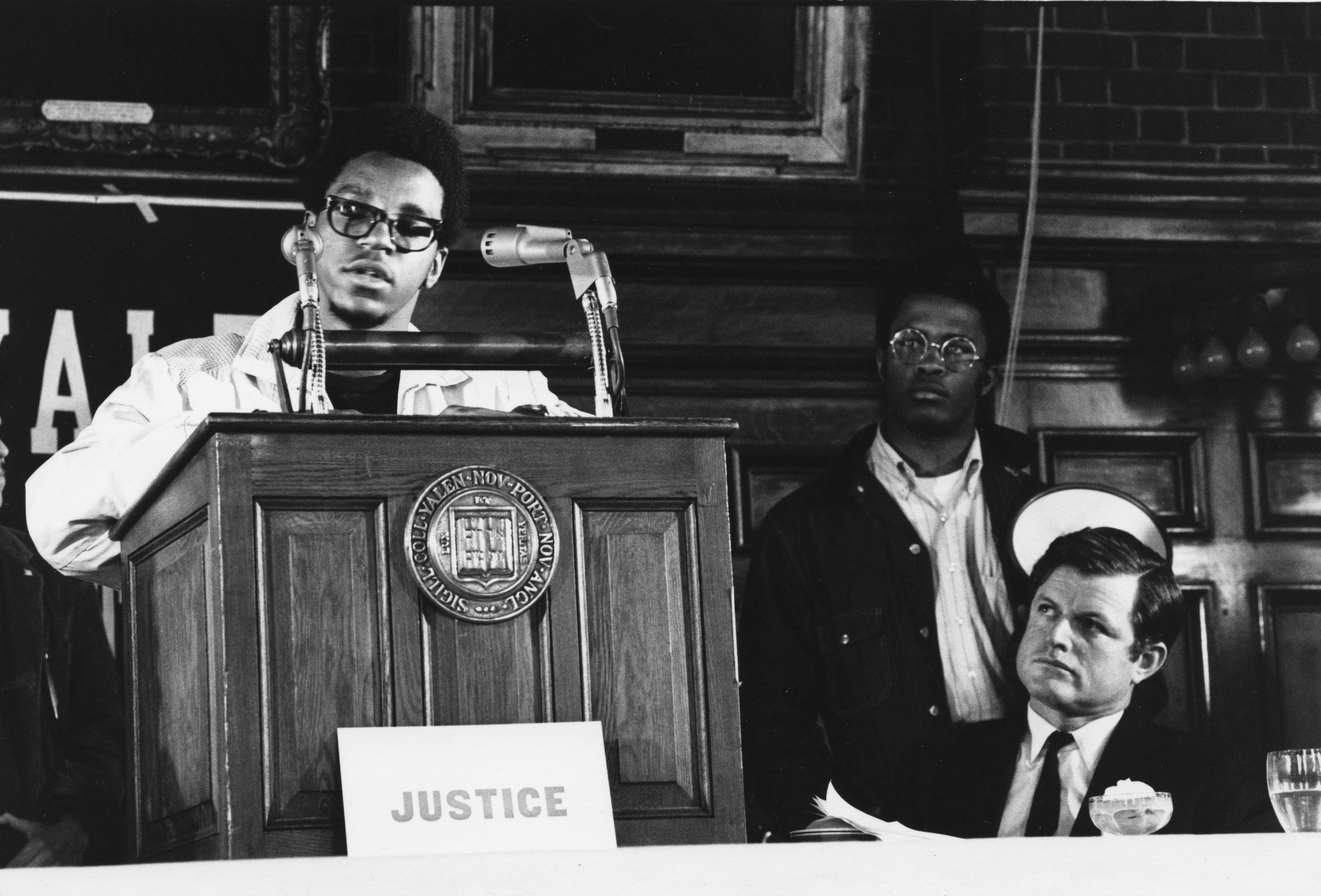
In the heady days of the spring of 1970, Senator Edward M. Kennedy came to Yale on Earth Day (April 22, 1970) to speak, on the occasion of the nation’s first Earth Day, at a Yale Political Union luncheon in Commons. In the afternoon after Kennedy’s speech, a teach-in on “The Politics of Pollution” was scheduled in the Yale Law School auditorium.

Earth Day in 1970 coincided with the pre-trial proceedings for the “New Haven Nine” trials and increasing tensions in New Haven and on the Yale campus over the heavy-handed response of the Nixon administration and the FBI’s secret Counter-Intelligence Program (COINTELPRO) to the 1969 kidnapping, torture, and murder by members of the Black Panther Party of Alex Rackley, a New Haven Black Panther member who was suspected of being an FBI informant. These events ultimately led to the May Day strike/rally on May 1-3, 1970, and the temporary suspension of academic activities at Yale.

Student protests over the Black Panther trials spilled over into the Earth Day events when Ralph Dawson, Class of 1971 and moderator of the Black Students Alliance at Yale (BSAY), and Kurt Schmoke, Secretary of the Class of 1971, interrupted the Yale Political Union luncheon to appeal for support for the jailed New Haven Black Panthers. That cross-fertilization of activism was captured in this image from the May 1970 issue of the Yale Alumni Magazine, and can also found in the collections of Manuscripts and Archives.

Tips on Researching pre-20th C. Yalies

On Wednesday morning, April 10th, Yale alumnus David Richards (1967 B.A., 1972 J.D.) made a presentation to Manuscripts and Archives staff on research he’s been conducting into the impact of Senior (aka secret) societies on Yale’s administration and governance. He offered some very useful tips for researching Yale students and student life for the period before the growth of student publications at Yale during the last quarter of the 19th century. Links from items discussed below to freely available digital copies in Google Books are provided when they exist.

  1. Read Four Years at Yale (New Haven: Charles C. Chatfield & Co., 1871) by Lyman Hotchkiss Bagg (1869 B.A.). According to Richards this is the most comprehensive record of the annual cycle of student life at Yale in the mid-19th century.
  2. Browse the lists of members in fraternity catalogs for Phi Beta Kappa (1898 catalog link provided), and the Yale Junior fraternities Alpha Delta Phi (1909 catalog link provided), Psi Upsilon (1902 catalog link provided), and Delta Kappa Epsilon (1910 catalog link provided), many editions of which have been digitized and are available in Google Books. These contain a surprising amount of data about individual students and cover significant percentages of Yale classes, especially during the 19th-century time period. For example, according to Richards’ calculations, out of the 110 members of the Yale College Class of 1853, information about 74 students can be found in the three Junior fraternity catalogs.
  3. Explore Anson Phelps Stokes’ Memorials of Eminent Yale Men: A Biographical Study of Student Life and University Influences During the Eighteenth and Nineteenth Centuries (New Haven: Yale University Press, 1914). These biographies of the more famous co-graduates of a particular class provide a good flavor of student life during the time period and glimpses of other members of the class. Other single-subject biographies can serve the same purpose in establishing context for understanding the life of a student in a specific Yale College class or era, for example, John A. Garver’s John William Sterling, Class of 1864, Yale College: A Biographical Sketch (New Haven: Yale University Press, 1929).

In our alumni-related reference work in Manuscripts and Archives we rely heavily on student publications and class books, which did not come into routine existence until late in the 19th century. Richards’ research reminds us all of the potential of other resources for researching Yalies of an earlier era.

Documentary Filming Over the Weekend

Manuscripts and Archives played host on Saturday to Harvard Professor Henry Louis Gates, Jr. (’73 B.A.) and Howard University Vice President and General Counsel and former Baltimore mayor Kurt Schmoke (’71 B.A.). These two Yale alumni were joined by a crew from Ark Media filming the sixth and final episode of the forthcoming PBS documentary series The African Americans: Many Rivers to Cross, for which Professor Gates is serving as host. The episode filmed in Manuscripts and Archives features Gates interviewing Schmoke about his participation as a Yale undergraduate in the 1970 events surrounding the May Day strike and New Haven Black Panther trials. The rich collections in Manuscripts and Archives documenting the May Day strike served as memory stimulation for these gentlemen as they reminisced about their experiences as Yalies during the Civil Rights era. Tune into your local PBS station in October-November 2013 to see what promises to be, at least judging from the interview for episode six to which I was privileged to listen, a fascinating and worthwhile documentary.

Opening of the Lindbergh Family Papers

On Thursday afternoon, April 4, 2013, Manuscripts and Archives and the Yale University Library hosted an event marking the formal opening of the Charles Augustus Lindbergh Papers (MS 325), Anne Morrow Lindbergh Papers (MS 829), and the Lindbergh Picture Collection (MS 235B). Speakers for the program were Dorothy Cochrane, Curator, Smithsonian National Air and Space Museum, Aeronautics Division; Reeve Lindbergh, Author and daughter of Charles A. and Anne Morrow Lindbergh; Edward Trippe, Chairman, Pan Am Historical Foundation, and son of Juan Trippe; and Jenifer Van Vleck, Assistant Professor, American History and American Studies, Yale University. The event was attended as well by several members of the Lindbergh, Trippe, and Sikorsky families, including Reeve Lindbergh’s brother, Land.

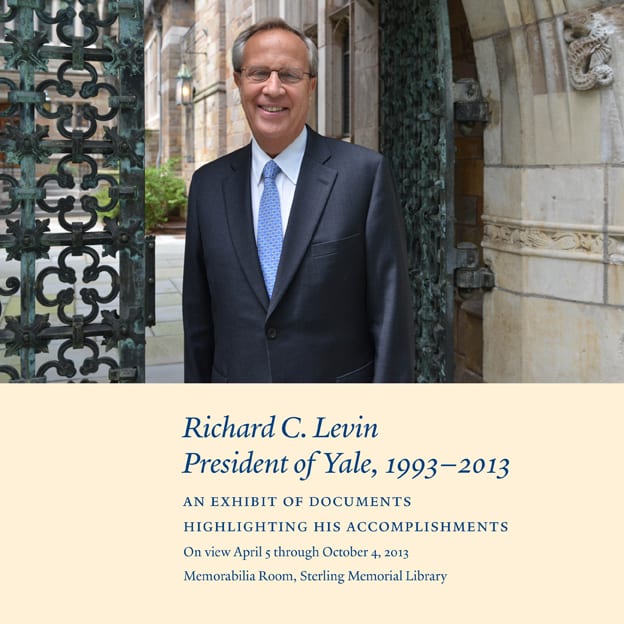
Levin Exhibit Opens

April 5 – October 4, 2013
Memorabilia Room, Sterling Memorial Library

This exhibit celebrates accomplishments during the presidency of Richard C. Levin on the occasion of his stepping down from office. Photographs, memorabilia, correspondence, speeches, and printed ephemera from Richard C. Levin Presidential Records in Manuscripts and Archives and photographs from the Office of Public Affairs and Communications document selected noteworthy milestones during his twenty years of service as president of the University. The exhibit highlights the inauguration of President Levin in 1993, the Yale Tercentennial in 2001, Yale’s international programs and distinguished visitors, the purchase of the Yale University West Campus, and examples of Yale-New Haven initiatives such as the creation of the Yale Homebuyer’s program and the New Haven Promise scholarship program. President Levin has stated that his greatest accomplishments are transforming Yale from “what used to be an aloof ivory tower into the leading corporate citizen of New Haven” and promoting the university’s new focus on global issues.

The exhibit is curated by Manuscripts & Archives staff members. For more information contact mssa.reference@yale.edu or (203) 432-1744.

The exhibit is free and open to the public Monday-Friday, 8:30 AM-4:45 PM.

For more information about exhibits and events at the Yale University Library: http://calendar.yale.edu/cal/library/